Portal login ↗
Menu

Our Curriculum

Learning through
everyday adventures.

Our curriculum is inspired by “50 Things to Do Before You’re Five.” We follow your child’s interests and support their goals through engaging experiences that help them discover the world and build happy memories.

Growing together

Goals for each room

Baby Room

0–2 years

  • Create secure attachments, seeking comfort when needed, feeling safe and trusting special adults
  • Transition between rooms/garden/from home confidently, walking where possible.
  • Drink from cup, sit without straps for mealtimes
  • Experience a variety of Sensory Exploration
  • Follow simple instructions
  • Communication – Encourage early communication skills
  • Emotional regulation – support them to identify and regulate emotions
  • Routine and predictability – Establish consistent routines to create a sense of security
  • Social interaction - facilitate positive interactions between peers, caregivers etc
  • Physical development – support the development of gross and fine motor skills

Toddler Room

2 year olds

  • Social skills – Encourage parallel play and simple interactions, fostering the development of sharing, turn taking, waiting and basic cooperation.
  • Language development – Support expansion of vocabulary, sentence formation and communication through conversations, stories, and songs.
  • Independence – Promote self-help skills, including dressing, using utensils, potty training.
  • Fine and gross motor skills – provide activities that enhance these skills like drawing, stacking blocks, running, jumping
  • Emotional Regulation – Help toddlers identify and express emotions while encouraging coping strategies for managing feelings
  • To be able to follow and anticipate nursery routine
  • To be able to sit for short periods at group time
  • To be able to follow simple instructions
  • Safety awareness – To teach basic safety rules and practices to ensure toddlers- well being in various environments.
  • Be content enough to express needs and to be considerate of others

Pre-school Room

3–4 year olds

  • Resilience, Independence, and responsibility- encourage independence in tasks like self-care and tidying up, fostering a sense of responsibility for personal belongings and shared spaces.
  • Respect for nature and the environment – through outdoor play, forest school sessions and experiences (Recycling, Growing, caring for insects etc)
  • Road safety Skills – build these skills on walk to garden, outings, minibus safety on the way to forest school to ensure well-being of children in various environments
Fabric illustration: Kimmy’s preschool room with activity tables, a book corner and a wooden play kitchen.
  • Socialising – Develop advanced social skills such as cooperative play, sharing, turn taking, to prepare children for interactions in a classroom setting
  • Cultural Awareness – Introduce age-appropriate concepts of diversity, cultural awareness, and acceptance through stories, discussions, and activities.
  • Following Instructions- Develop the ability to follow simple instructions and participate in group activities, preparing for a more structured learning environment.
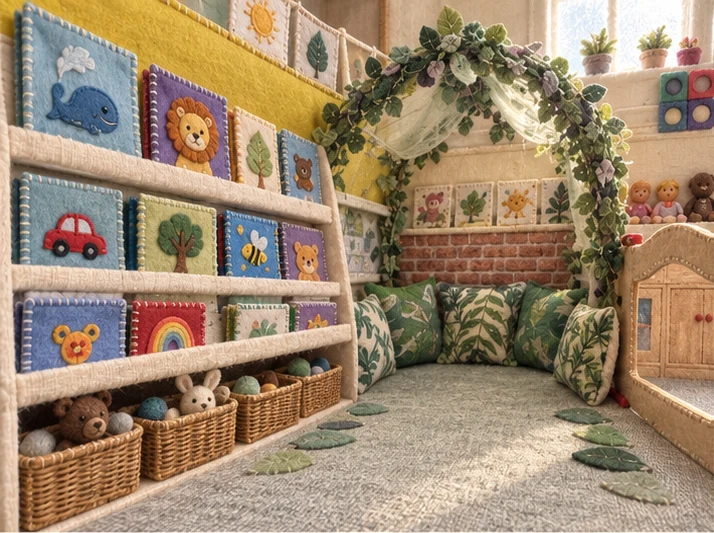
Fabric illustration: Preschool book corner with low bookshelves, cushions and a leafy arch.
  • Emotional Intelligence – Continue building emotional intelligence by helping children identify and express emotions and fostering empathy towards peers.
  • Imagination and Creativity – Nurture creativity through imaginative play, storytelling, arts and crafts, allowing children to express themselves freely.
  • Early Literacy and Numeracy – Introduce pre-reading skills, letter recognition, basic phonics, and early numeracy concepts through age-appropriate activities and games.
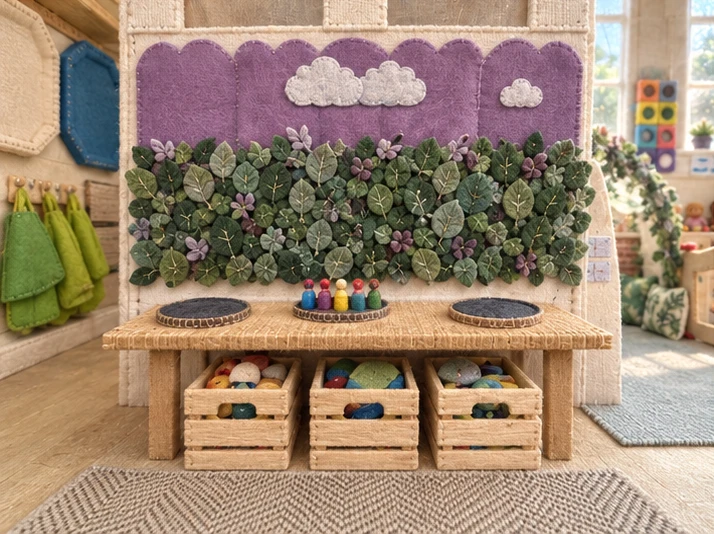
Fabric illustration: Preschool activity station with play trays and accessible storage baskets.
  • Problem Solving Skills – Encourage critical thinking and problem solving through puzzles, games, and open-ended activities.
  • Language Development- Foster advanced language skills, including expanding vocabulary, clear communication, and active participation in group discussions.
  • Fine Motor Skills-Refine fine motor skills through activities such as cutting, drawing, using manipulative materials, preparing for writing readiness.
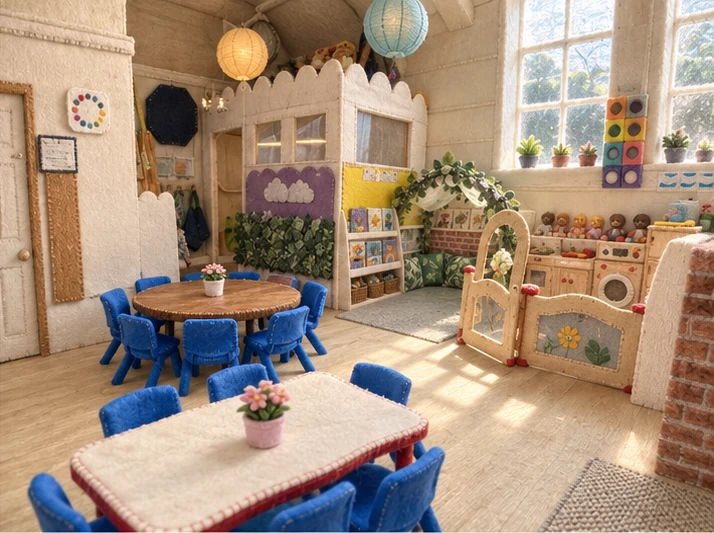
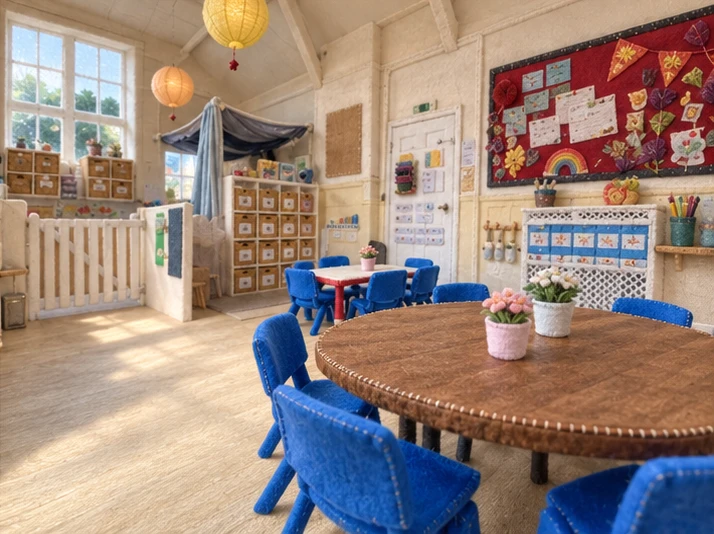
Fabric illustration: Preschool group tables with blue chairs and learning displays around the room.

01 · Everyday experiences

Our Curriculum

A learning journey of their own

We are thrilled to announce our engaging new curriculum inspired by ‘50 Things to Do Before You’re 5.’

At Kimmy’s, we work hard to keep our activities interesting and engaging for your little ones, whilst following their interests and helping them to achieve their goals.

Our seasons of discovery

We have found the ‘50 things to do before you’re 5’ app, which is free to download, is a fantastic way to do just this! We’ve decided to scrap our ‘themes’ and change it simply to just four, these will be ‘Spring, Summer, Autumn and Winter’.  The cards have been carefully designed to give your little one life experiences and build happy memories. They help them learn about the world they live in and give you the opportunity to talk together, developing essential language and vocabulary.

One card. A week of possibilities.

Each week, we’ll explore one card from the collection, tailoring activities using your child’s interests, their goals, and your valuable feedback to create a personalised learning journey for your little one. We believe this will not only enhance their development but also make their time with us even more enjoyable.

We look forward to sharing this adventure with your child and appreciate your continued support. We have printed out and attached with this letter our new themes, with the cards we will be using each week, for you to have so you can get involved at home too!

Bring the adventure home

Check out the app, Facebook or website ‘50 things to do before you’re 5’, make sure you select the region you wish it to be tailored to, to find out more information and to join in with some of the fantastic activities.

Download the free app '50 Things to do before you're five'

Follow '50 Things East Sussex' - on Facebook

Follow East Sussex Parents - on Instagram

If you would like more information, please don’t hesitate to speak to us! We will be happy to discuss this in more detail, answer any questions, or loan you some activities to support your child at home.

02 · Our early years foundations

EYFS Birth to 5 Matters

EYFS Birth to 5 Matters

Birth to 5 Matters is a nonstatutory early years guidance framework (latest edition 2026) created by the Early Years Coalition to support practitioners in delivering the EYFS, emphasising childcentred practice, inclusion, play, and holistic development.

Overview

Birth to 5 Matters is sectorled guidance designed to complement the statutory Early Years Foundation Stage (EYFS). It updates earlier materials to reflect current research and societal needs, supporting educators working with children from birth to age five.

The child at the heart

Core Principles

The framework reaffirms key principles:

The child at the centre of practice, recognising individuality and agency.

Connections to family, community, culture, and the natural world.

Holistic development across physical, social, emotional, and cognitive domains.

Children’s rights under the UNCRC, including nondiscrimination, best interests, right to be heard, and right to play.

Commitment to sustainability and inclusion, aligned with UN Sustainable Development Goals.

Four foundations for learning

Structure of the Framework

Birth to 5 Matters is organised around the four EYFS principles:

A Unique Child

Child development

Selfregulation

Characteristics of Effective Learning

Equality, equity, diversity, and inclusion

Learning and Development

Developmental guidance for:

Birth to 2

2yearolds

3–4yearolds

Reception and beyond

Areas of learning: PSED, Communication & Language, Physical Development, Literacy, Mathematics, Understanding the World, Expressive Arts & Design

Purpose and Use

The framework helps practitioners:

Interpret EYFS requirements

Plan developmentally appropriate learning

Observe and assess children

Support progress toward Early Learning Goals

It is freely available online as a PDF and can be used across all early years settings.

The Birth to 5 Matters framework remains a widely used sectorled resource supporting highquality, childcentred early years practice.